

High Speed Glazed Tile Roll Forming Machine: Holding Step-Tile Geometry at 12 m/min
writer:优化 release time:2026-10-07 20:52:17 Views:107frequency
Selecting a high speed glazed tile roll forming machine is rarely about finding the cheapest frame on the market. It is about controlling the one variable that decides whether a decorative roof sells or gets rejected on site: step-tile geometry that stays identical from the first metre to the ten-thousandth. For roofing contractors and building-material distributors serving heritage-style projects, the choice of a glazed tile line represents a strategic decision to prioritise profile repeatability over short-term procurement savings.
The complexity of the glazed tile profile — deep ribs, a pressed step face, and a tight arc transition — punishes any line that is under-powered, under-gauged, or poorly commissioned. A drift of one millimetre in step height becomes a visible shadow line once tiles are lapped across a roof plane. Whether you are supplying a resort development or a municipal restoration project, the integrity of the formed tile is the only barrier between a clean handover and a costly re-roof.
Why the Glazed Tile Profile Is the Hardest Shape to Hold
A trapezoidal roof panel is forgiving: the bend radii are generous and the strip feeds smoothly from pass to pass. A glazed tile is not. The profile combines progressive roll forming with a pressing (embossing) stage that stamps evenly spaced step segments across the sheet width. That pressing stage introduces a second deformation cycle after the metal has already work-hardened, so any residual springback shows up as an uneven step face or a wavy arc.
Three failure modes dominate field complaints, and all three are machine problems rather than operator problems:
Step-height drift — caused by roller sets that are too soft or a press cylinder that lacks tonnage at speed.
Edge bow and camber — caused by asymmetric pass design or a frame that flexes under load.
Cut-length scatter — caused by a shear that stops the line, or by encoder feedback with poor resolution.
Engineering note: Because the tile is a visible architectural element, tolerance is a commercial specification, not just a technical one. Hengfu targets a cut-length error of ≤ 1 mm on its glazed tile lines so that tiles lap without daylight at the seam.
How a Glazed Tile Roll Forming Line Works
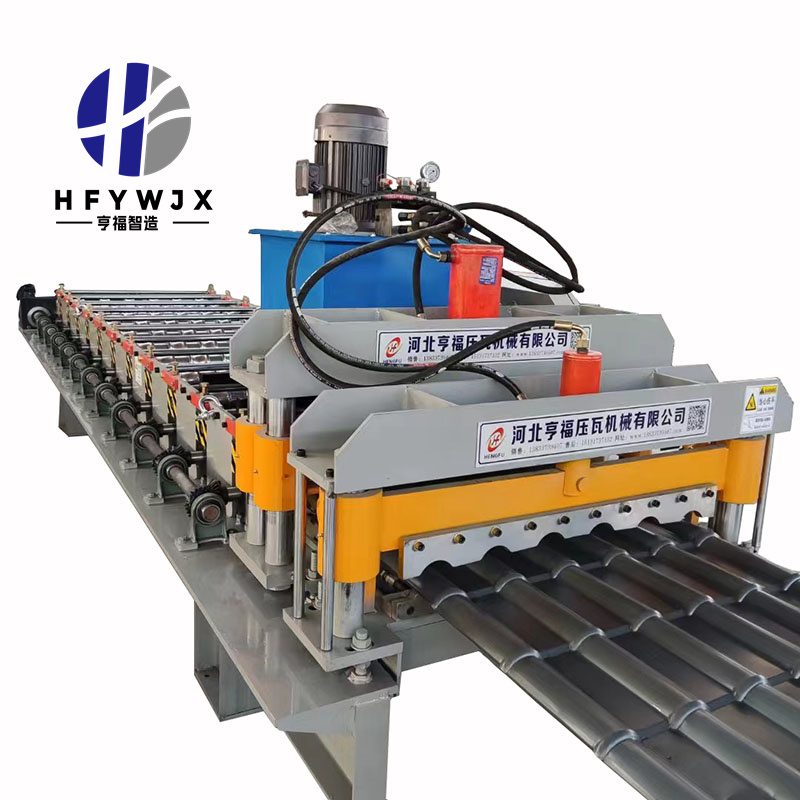
A modern glazed tile roll forming machine is a continuous line built from five coordinated sections:
Passive or hydraulic decoiler — holds the coil and feeds strip without surface scoring.
Feeding and guiding section — centres the strip so the step pattern stays symmetric to the sheet edge.
Roll forming host — 16 to 21 forming stations progressively bend the flat strip into the arc profile.
Pressing (embossing) section — a hydraulic or servo-driven mould stamps the step segments in one stroke.
Post-forming shear and run-out — cuts to length, either by stop-and-cut or by a flying shear.
Control runs through a PLC with touch-screen HMI, a frequency converter for speed control, and an encoder that closes the loop on cut length. On Hengfu's 1100 and 1110 configurations the shear is a post-forming double linear guide electric shear, a patented arrangement that keeps the blade square to the profile through the full cutting stroke.
Core Performance Factors to Specify
| Parameter | Why it matters on a glazed tile line | Typical Hengfu specification |
|---|---|---|
| Forming stations | More passes = gentler bend per pass = less springback and sharper step definition | 16–21 rows |
| Roll material | Soft rolls wear, and worn rolls change the arc radius over a production year | 45Cr steel, quenched + tempered, fine turned, hard chrome plated |
| Main shaft | A hollow or undersized shaft deflects under press load and opens tolerance | Φ80 mm solid shaft |
| Machine frame | Frame flex shows up as profile twist on wide sheet | 400H standard steel, 16 mm wall plates |
| Drive | Gearbox drive holds synchronisation better than long chain runs at higher speed | Gearbox drive, 11 kW servo main motor |
| Cutting blade | Blade hardness decides burr height and re-grind interval | Cr12MoV, quenched to 58–62 HRC |
| Production speed | The real constraint is the press cycle, not the rollers | 4–12 m/min |
| Material range | Wider gauge range means one line serves more market segments | 0.3–0.8 mm PPGI / PPGL / GI / GL, Q235 |
980 vs 1100 vs 1110: Choosing the Right Tile Width
| Model | Feeding width | Typical thickness | Speed | Best application |
|---|---|---|---|---|
| 980 glazed tile | 1000–1250 mm | 0.3–0.5 mm | 4–6 m/min | Residential and light commercial roofing, cost-sensitive markets |
| 1100 glazed tile | 1200 mm | 0.3–0.8 mm | 4–5 m/min | Garden-style factories, pavilions, scenic-area architecture |
| 1110 partial arc (YX24-222-1110) | 1250 mm | 0.3–0.5 mm | 4–12 m/min | High-volume decorative roofing where appearance consistency is contractual |
The trade-off is straightforward: wider feed width covers more roof area per sheet and reduces labour at installation, but it demands more forming stations and a stiffer frame. Narrower machines cost less to buy and to ship, and they suit distributors whose market stocks 1000 mm coil as standard.
Where Glazed Tile Roofing Pays Back Fastest
Antique-style glazed tile has moved from a niche restoration product into mainstream steel-structure architecture. The strongest demand clusters are:
Scenic areas and cultural tourism projects — pavilions, corridors and gatehouses where planning rules demand a traditional roof silhouette.
Garden-style industrial parks — factory and office blocks that need the appearance of clay tile with the weight and cost of steel.
Hotels, resorts and villa developments — where the roof is a marketing asset and colour retention matters.
Municipal and school buildings — long-span roofs where clay tile is too heavy for the purlin design.
Finished tiles are light, strong and load-bearing, which lets structural engineers widen purlin spacing and cut steel tonnage elsewhere in the building. That system-level saving is often larger than the machine price difference between a light and a heavy line.
Buying Checklist: What to Confirm Before You Order
Specify these seven items in writing and most commissioning disputes disappear:
Profile drawing with step height, pitch and arc radius dimensioned, signed off before roller design starts.
Coil spec: width, thickness range, yield grade (Q235 / Q345), coating (Z275 galvanise, PVDF, HDP).
Cut-length tolerance and whether shear is stop-and-cut or non-stop flying shear.
Roll material and heat-treatment certificate — 45Cr quenched and tempered, not 45# as-rolled.
Electrical standard for your market: 380 V 3-phase 50 Hz or 220 V / 415 V / 60 Hz variants.
Control brand preference — Delta, Siemens or Mitsubishi PLC, and HMI language.
Scope of commissioning: installation, operator training, and whether technicians travel to site.
Hengfu builds to customer profile drawings rather than to a fixed catalogue, so the practical sequence is: send the tile drawing or a photo of the finished tile → receive a roller design and line layout → confirm the specification sheet → production → trial run at the factory → shipment.
Operating Cost and Maintenance Reality
Total cost of ownership on a metal roof tile machine is dominated by three consumables: rolls, blades and hydraulic oil. Rolls kept lubricated and protected from coil-edge damage typically run for years before re-grinding; blades are the faster wear item and should be specified as a spare set in the original order, because a blunt blade produces burrs that scratch the coating of the next sheet in the stack.
Budget for an annual inspection of chain or gearbox tension, encoder mounting, and hydraulic pressure stability. A line that drifts 0.5 mm per year in cut length will quietly produce roof sheets that no longer lap correctly — the kind of defect discovered by the installer, not by the factory.
Future Trends in Decorative Steel Roofing
Three shifts are reshaping the glazed tile segment. Pre-painted and textured coatings now reproduce the matte look of fired clay, which widens the acceptable market far beyond heritage projects. Servo-driven pressing is replacing pure hydraulic stamping on higher-end lines, giving adjustable step depth without mechanical shimming. And automatic stackers are moving from optional to expected, because labour cost per bundle is now a larger share of delivered cost than the steel itself.
For buyers, the implication is to buy a frame and control platform with headroom: a line designed for 12 m/min and a servo upgrade will still be competitive in five years, while a minimum-specification line will not.
Frequently Asked Questions
Q: What thickness of colour steel can a glazed tile roll forming machine run?
Most Hengfu glazed tile lines handle 0.3-0.8 mm in PPGI, PPGL, galvanised and Galvalume coil. Narrow-width models such as the 980 are commonly specified at 0.3-0.5 mm, while the 1100 and 1110 frames accept the full 0.8 mm range.
Q: How accurate is the cut length?
With PLC encoder feedback and a post-forming linear guide shear, cut-length error is held to 1 mm or better. Accuracy depends on the encoder resolution and on the shear being square to the profile, which is why the double linear guide arrangement matters.
Q: Can one machine produce more than one tile profile?
A single roller set produces one profile. Changing profile means changing the roller set, or specifying a double-layer or quick-change frame. Buyers with two high-volume profiles usually find a double layer machine cheaper than two separate lines.
Q: What is the delivery time?
Standard glazed tile lines are typically built in about 45 days from confirmed specification. Custom profiles with new roller design may add time for tooling and trial production.
Q: Do you provide installation and training?
Yes. Hengfu provides design, production, installation, commissioning and maintenance as a one-stop service, with technicians available for on-site commissioning and operator training.
Talk to the Hengfu Engineering Team
Dongguang County Hengfu Roll Forming Machinery Co., Ltd. designs and builds roll forming lines in Cangzhou, Hebei — from standalone tile machines to complete automated production lines. Every line is delivered with design, production, installation, commissioning and lifetime technical support.
Profile drawing → roller design → trial production → shipment → on-site commissioning.
Request a Quote & Profile Design