

Corrugated Sheet Roll Forming Machine 780 and 836: Non-Stop Shearing for High-Volume Roofing
writer:优化 release time:2026-10-16 21:28:15 Views:149frequency
Choosing a corrugated sheet roll forming machine is rarely about innovating. It is about producing the highest tonnage of saleable sheet per shift at the lowest cost per metre. The corrugated wave is the oldest and still the highest-volume metal roof profile in the world, and for distributors filling container orders to price-driven markets, output per hour is the only metric that matters.
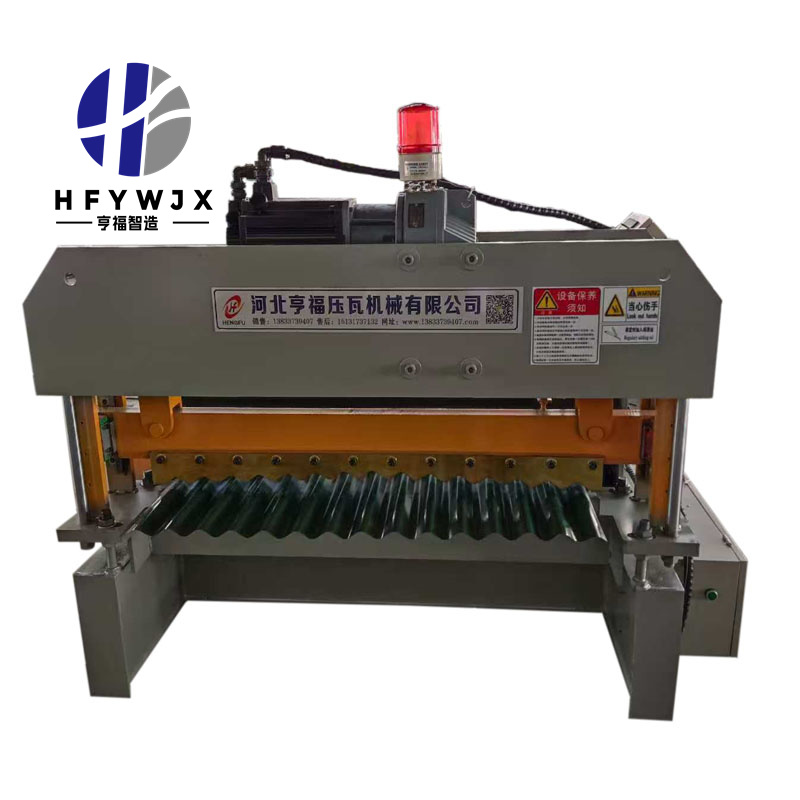
That is why the specification decision that matters most is not the profile — it is whether the shear stops the line. A non-stop shearing (flying shear) configuration cuts the panel to length while the line keeps moving, removing the stop-and-go cycle that caps the output of ordinary lines.
Why Corrugated Still Leads Global Volume
Corrugated sheet wins on three properties: it is cheap to make, stiff for its weight, and familiar to every roofer on earth. For warehouses, farm buildings, and utility structures where appearance is secondary to cost and span, nothing competes. The 780 and 836 geometries are regional standards that distributors stock by the kilometre.
Structurally, the sinusoid is efficient: the same steel yields far higher bending stiffness than a flat sheet, which is why corrugated roofs span wider purlin spacings than flat cladding of identical gauge.
Mechanical Principle of Wave Forming
A corrugated line progressively bends the strip through multiple shallow passes until the full wave is set, then shears to length. Because the wave is gentle, fewer stations are needed than for a deep step-tile profile, so line speed stays high.
Two details decide whether the wave stays symmetric edge to edge: roller hardness, and frame stiffness. Hengfu specifies 45# chrome-plated rollers and a 250H frame on its corrugated lines — symmetry matters because overlapping sheets must seal at the crest, and a skewed wave leaves a gap.
Non-Stop Shearing: The Output Multiplier
| Stop-and-cut shear | Non-stop (flying) shear | |
|---|---|---|
| Line motion during cut | Line halts, then restarts | Line runs continuously |
| Effective output | Limited by acceleration cycle | Limited by forming speed only |
| Acceleration stress | Repeated start-stop loads chains, gearbox and motor | Steady-state running, longer drivetrain life |
| Length accuracy | Good | Good, with servo or encoder-controlled blade carriage |
| Best for | Low-volume, mixed-length jobbing work | Container-order, high-volume distribution |
Rule of thumb: if more than 60% of your orders are long runs of a single length, non-stop shearing pays back within the first production season.
780 Roofing vs 836 Wall Sheet
| Model | Typical pitch and depth | Primary use | Market note |
|---|---|---|---|
| 780 | Standard wave, deeper profile | Roofing and general cladding | The volume standard for agricultural and industrial roofing in many export markets |
| 836 | Tighter pitch, shallower wave | Wall cladding and siding | Reads cleaner on vertical surfaces; also used for fencing |
With the correct roller set, the same line family serves both roofing and wall cladding in matched gauges, which is why many distributors specify a corrugated frame with a second roller set held in store.
Coating and Material Specification
Z275 galvanise — the utility default. Adequate for agricultural and industrial buildings with no architectural requirement.
Pre-painted (PPGI / PPGL) — standard for visible roofs; specify paint system by environment, not by price.
PVDF / HDP — for architectural and coastal exposure where colour retention and chalk resistance are contractual.
Anti-condensation backing — increasingly specified on uninsulated agricultural buildings to stop underside dripping.
Confirm coil width and thickness against the machine specification — most corrugated lines are built for 0.3–0.8 mm across common 914/1000/1200/1220/1250 mm coil widths.
Corrugated vs Trapezoidal Rib
| Factor | Corrugated | Trapezoidal rib |
|---|---|---|
| Relative cost | Lower | Medium |
| Stiffness / weight | High | High |
| Overlap seal | Crest-to-crest | Side lap |
| Line speed | Very high | High |
| Best use | Roof, farm, utility buildings | Wall and roof, commercial buildings |
What to Specify Before Ordering
Six checks before you sign:
Profile drawing — 780 or 836, with pitch, depth and cover width dimensioned.
Shear type — confirm non-stop flying shear if volume justifies it.
Edge straightness tolerance and how it is measured at commissioning.
Coating and gauge range you intend to run, including maximum thickness.
Roller material and heat treatment certificate.
Whether an automatic stacker and hydraulic decoiler are in scope.
Operating Reality and Future Trends
Corrugated lines are the most forgiving machines in a roll forming fleet, and that is exactly why they get neglected. Keep rollers clean of zinc build-up, check chain tension monthly, and log cut-length drift — a line that degrades slowly is harder to notice than one that fails.
Looking ahead, pre-painted and anti-condensation backed corrugated continues to gain share, and servo non-stop shears are replacing mechanical flying shears on higher-end lines. For emerging markets where price rules, corrugated remains the volume king for decades to come — the winning move is not to change the profile but to raise output per shift.
Frequently Asked Questions
Q: What is non-stop shearing?
A flying shear cuts the panel to length while the line keeps moving, eliminating the stop-and-go cycle that limits the output of ordinary lines.
Q: Which model covers roofing versus wall cladding?
780 and 836 are common geometries. 780 is used predominantly for roofing; the tighter-pitch 836 reads cleaner on wall cladding and siding.
Q: How stiff is corrugated compared with flat sheet?
The wave multiplies bending stiffness for the same steel weight, which allows wider purlin spacing and lighter supporting structure.
Q: What coating should I specify?
Z275 galvanise for utility and agricultural use; PVDF or HDP pre-painted coil for visible architectural applications and coastal environments.
Q: Can one line make both roof and wall sheet?
Yes. With the correct roller set, the same line family serves roofing and wall cladding in matched gauges.