

Ridge Cap Roll Forming Machine 310 and 460: Finishing the Roof Line Without Leaks
writer:优化 release time:2026-10-19 22:23:44 Views:62frequency
Specifying a ridge cap roll forming machine is rarely treated as a strategic decision — and that is precisely why it causes problems. The ridge is the highest-stress junction on any metal roof: it takes thermal movement from both slopes, wind uplift from two directions, and it is the detail that visibly fails first when geometry is wrong. For contractors and panel distributors, the ridge cap is a low-cost component carrying high-consequence risk.
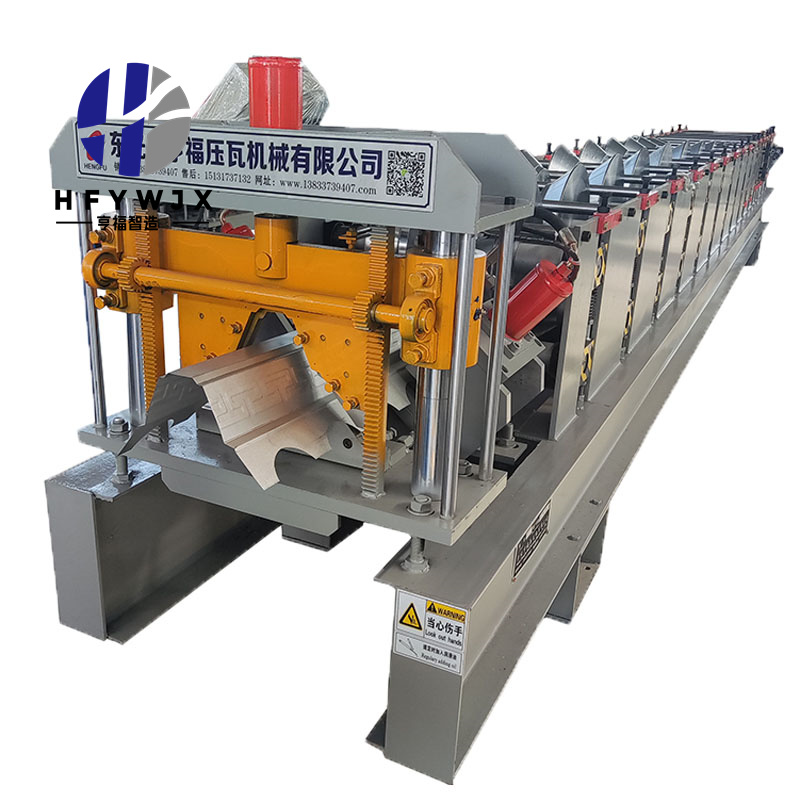
The 310 and 460 ridge cap geometries cover the majority of trapezoidal and corrugated roof systems in export markets. Producing them in-house, rather than buying bent flashing from a third party, is usually the fastest payback investment a roofing plant can make.
Why the Ridge Detail Fails
A ridge cap must do three things simultaneously: bridge two panel slopes whose angle varies with purlin tolerance, accommodate thermal movement without tearing fixings, and shed water driven by wind from either side. Most callbacks trace back to one of three root causes:
Wrong included angle — the cap was bent to a nominal roof pitch that does not match the as-built frame.
Wrong profile match — the cap does not follow the rib pattern of the panel it closes, leaving gaps at every crest.
Wrong material — a softer or thinner coil than the panels, so the cap deforms first under wind load.
Specify the cap against the panel, not in isolation. Send the panel profile drawing with the ridge order. A cap designed against the actual rib geometry seals; one designed against a catalogue drawing usually does not.
How a Ridge Cap Roll Forming Machine Works
The line is compact compared with a panel machine: a decoiler, a feed guide, a forming section of progressively shaped passes, and a bending device that sets the included angle. On the 430 high-altitude ridge cap configuration, the equipment comprises a loading rack, loading rack support, feed introduction platform, forming host, and forming-and-shearing device, running aluminium-magnesium-manganese coil at 600 mm feed width through 14 forming rows on a 350H frame with a Φ70 mm solid shaft.
Cutting is by three-blade linear guide cutting after forming, which gives a clean edge without the burr that makes cap joints sit proud of each other.
310 vs 460: Selecting the Cap Width
| Model | Typical application | Selection logic |
|---|---|---|
| 310 ridge cap | Residential and light commercial roofs, narrower rib panels | Matches smaller cover-width panels; less material per metre and easier handling at height |
| 460 ridge cap | Industrial and warehouse roofs, wider trapezoidal panels | Provides the coverage needed to close deep ribs and to lap over profiled foam closures |
| Square ridge tile | Heritage-style and glazed tile roofs | Used where the roof design calls for a squared apex rather than a rounded bend |
Core Performance Factors
| Factor | Why it matters |
|---|---|
| Included-angle adjustability | Roof pitch varies frame to frame; an adjustable bend saves rework on site |
| Forming row count | Enough passes to set the bend without sheet marking or orange-peel on painted coil |
| Roll finish | Polished and plated rolls prevent coating damage on pre-painted coil — the most visible defect on a ridge |
| Cut quality | Burr-free cut lets consecutive caps butt cleanly along the ridge line |
| Material match | Cap gauge and coating should equal or exceed the panel specification |
| Profiled closures | Ribbed foam closures should be specified with the cap, not as an afterthought |
In-House Production vs Bought-In Flashing
| Factor | In-house ridge cap machine | Bought-in bent flashing |
|---|---|---|
| Unit cost | Coil cost plus minutes of machine time | Fabricator margin, handling and delivery |
| Lead time | Same day | Days to weeks, often the critical path |
| Profile match | Exact — built to your panel drawing | Approximate, usually to a generic profile |
| Length flexibility | Any length, cut to order | Standard lengths with joints |
| Capital requirement | One compact machine | None |
Distributors who already run panel machines typically recover the cost of a ridge cap line within one roofing season, largely because it removes the last subcontracted item from the roof package.
Buying Checklist
Confirm before ordering:
Panel profile drawing the cap must close, including rib height and pitch.
Roof pitch range on your projects, and whether the bend must be adjustable.
Cap model: 310, 460, or square ridge tile for glazed and heritage roofs.
Material — colour steel, galvanised, or aluminium-magnesium-manganese for architectural work.
Whether profiled foam closures and fixings are supplied with the machine order.
Cut type: three-blade linear guide cutting for burr-free joints.
Installation Details That Prevent Callbacks
Even a perfectly formed cap fails if installed badly. Set the cap on profiled closures rather than flat foam, fix through the closure into the purlin with the specified fastener spacing, and lap successive caps by at least one full rib with sealant in the lap. Leave thermal movement room at the ridge ends — a cap fixed rigidly at both ends will eventually tear its own fixings.
Future Trends
Two changes are visible in the accessories segment. Profiled closure systems are becoming standard specification rather than optional, driven by tighter air-tightness and warranty requirements. And colour-matched caps produced from the same coil batch as the panels are increasingly demanded, which favours in-house production over bought-in flashing.
Frequently Asked Questions
Q: What is the difference between the 310 and 460 ridge cap?
They differ in coverage width. The 310 suits narrower residential and light commercial panels, while the 460 provides the coverage needed to close wider industrial trapezoidal ribs and to lap over profiled foam closures.
Q: Can the machine produce square ridge tile as well?
Yes. Ridge cap and square ridge tile machines share the same forming principle; the square apex is specified for heritage-style and glazed tile roofs instead of a rounded bend.
Q: What material can be formed?
Colour steel and galvanised coil are standard. Aluminium-magnesium-manganese is used for architectural standing seam systems, as on the 430 high-altitude ridge cap configuration.
Q: Is the bend angle adjustable?
It should be. Specify an adjustable bending device so the cap can be set to the as-built roof pitch rather than a nominal catalogue angle.
Q: Why do ridge caps leak even when new?
Almost always a geometry mismatch: the cap does not follow the panel rib pattern, or the included angle does not match the as-built frame. Both are solved by designing the cap against the actual panel drawing.