

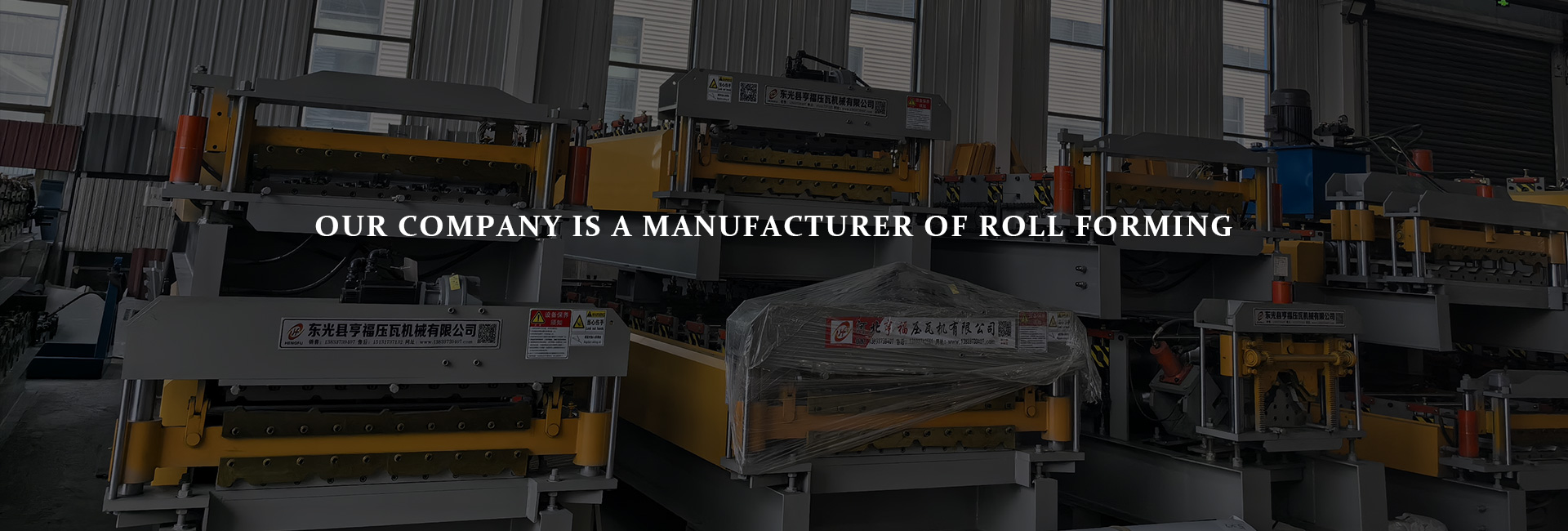
How to Choose a Roll Forming Machine Manufacturer in China: A Procurement Framework
writer:优化 release time:2026-11-04 14:07:15 Views:193frequency
Procuring a roll forming line from China requires a verified channel, because the specification sheet and the machine are frequently not the same thing. For plant managers and procurement engineers who cannot afford a line that arrives under-powered, mis-tooled or unsupported, the choice of a roll forming machine manufacturer in China represents a decision to prioritise verified capability over the lowest quotation.

The primary challenge is distinguishing between trading companies reselling generic machines and manufacturers who design, build and commission their own equipment. Using an unverified supplier often leads to premature tooling failure, profile error that no amount of adjustment can correct, and a machine with no one to call when it stops. This guide provides a professional framework for evaluating manufacturers.
Step 1: Confirm You Are Buying from a Manufacturer
This sounds obvious and is routinely skipped. A manufacturer owns the factory, the design team and the commissioning engineers. A trading company owns a relationship. Both can present a professional catalogue; only one can change a roller design when your profile is not forming correctly.
Verification checklist:
Business licence showing manufacturing scope, not trading scope.
Live video tour of the machining and assembly workshop, and of machines under test for other customers.
Factory address that matches the licence — Hengfu's facility, for example, covers 10,000 m² in Dongguang County, Cangzhou City, Hebei.
Names and roles of the design engineers who will work on your profile.
Willingness to run your profile or a comparable one during the visit.
Step 2: Evaluate Roller Design Competence
The machine frame is a commodity. The roller design is the product. Every competent manufacturer employs engineers who can take a profile drawing — or a photograph of a finished panel — and produce a flower diagram, station layout and roller set that forms it accurately.
| Question to ask | Weak answer | Strong answer |
|---|---|---|
| Can you work from my profile drawing? | "Send us the machine model you want" | "Send the drawing; we will return a flower diagram and station layout" |
| How many forming stations? | A fixed number regardless of profile | Calculated from material, thickness and bend radius |
| What is the roll material and treatment? | "45# steel" | 45Cr, quenched and tempered, fine turned, hard chrome plated |
| Can I see a trial run? | Not available | Trial production before shipment, with video |
Step 3: Check the Specification Against the Load Case
Under-specification is the most common failure in low quotations. A line quoted for 0.5 mm will technically run 0.8 mm, but it will do so with frame deflection, shaft stress and accelerated wear. Compare the quotation against your real duty:
| Item | What to verify |
|---|---|
| Frame | Steel section and wall-plate thickness sized for your maximum thickness, not your minimum |
| Main shaft | Solid shaft diameter appropriate to the load; hollow or undersized shafts deflect |
| Motor and drive | Power sized for maximum thickness and speed simultaneously, with margin |
| Control components | Named brands — PLC, inverter, encoder — not generic equivalents |
| Cut system | Blade material and hardness, and whether shear is stop-and-cut or flying |
| Electrical standard | Voltage and frequency for your country, including 60 Hz |
Step 4: Verify Export and Certification Track Record
Ask for evidence, not claims. A manufacturer with genuine export experience will have CE and SGS documentation, shipment records, and reference projects you can contact. Hengfu, for instance, has exported to 56 countries including Kenya, South Africa, Kazakhstan and Vietnam — the relevant point is not the number but that the documentation exists and can be checked.
Confirm also the HS code and packing method: machines are typically wrapped in plastic film and fixed with steel wire in the container, with rollers protected by rust-preventive oil and spare parts boxed separately.
Step 5: Interrogate the After-Sales Model
A roll forming machine is a long-term relationship, not a shipment. Before signing, establish:
Warranty terms — commonly 12 months, with lifetime technical support.
Spare parts policy — whether critical parts are shipped free within warranty, and who pays carriage.
Commissioning — whether technicians travel to your factory, and what the buyer covers (typically travel and accommodation).
Training — whether machine assembly and operator training are included.
Response time — what happens when the line stops during your peak season.
Test question: "If a part fails in month eight, describe exactly what you send and what I pay." A manufacturer with a real policy answers in one paragraph. A reseller forwards the question to someone else.
Step 6: Price the Total Cost, Not the Machine
| Cost element | Frequently overlooked |
|---|---|
| Machine price | Compared correctly only against identical specification |
| Tooling for future profiles | A cheap frame with expensive roller sets loses over time |
| Freight and installation | Container count, crane, foundation and electrical work |
| Commissioning travel | Flights, accommodation and technician days |
| Downtime risk | The cost of a stopped line in peak season dwarfs the price difference |
| Scrap during ramp-up | A well-commissioned line reaches saleable output in days, not weeks |
Why Cangzhou Is the Cluster That Matters
Cangzhou in Hebei Province is one of China's densest roll forming equipment clusters, with the machine builders, roller machining shops, control suppliers and export agents located within a short radius of each other. For a buyer, the practical benefit is depth of skill and speed of iteration: a profile change is a conversation with a roller shop down the road, not a month-long procurement exercise.
Hengfu operates in this cluster with multiple production lines and a technical team of around 100 people, covering design, production, marketing and after-sales service, and building high-speed roll forming lines plus supporting automated production lines. Its stated scope includes roof panel machines, high-altitude angle steel machines, aerial work platforms, floor deck machines, high-speed glazed tile machines, C/Z purlin machines, shearing machines and bending machines, with custom machinery and complete line solutions available.
A Practical Sequence for First-Time Buyers
Recommended sequence:
Send the profile drawing and coil specification — not a machine model number.
Receive the flower diagram, station layout and specification sheet; check frame, shaft, motor and control brands.
Request a video factory tour and a trial run of your profile or the closest equivalent.
Confirm warranty, commissioning scope and spare parts policy in writing.
Confirm electrical standard, packing and container count before payment terms are fixed.
Place the order with specification attached as a contractual annex.
Follow that sequence and the two risks that genuinely matter — wrong tooling and absent support — are both addressed before money moves.
Frequently Asked Questions
Q: How do I verify a supplier is really a manufacturer?
Check the business licence for manufacturing scope, request a live video tour of the machining and assembly workshop, confirm the factory address matches the licence, and ask to see machines under test for other customers.
Q: What should I send first - a machine model or a profile drawing?
A profile drawing. The roller design is derived from the profile, material and thickness, so a model number alone cannot produce an accurate quotation.
Q: What warranty and support should I expect?
Twelve months warranty with lifetime technical support is typical. Confirm whether failed parts are shipped free within warranty, who pays carriage, and whether technicians travel for installation and commissioning.
Q: Why do quotations for apparently similar machines differ so much?
Usually because of frame section, shaft diameter, motor power, roll material and control component brands. Compare specification line by line rather than comparing model names.
Q: Is custom profile development available?
Yes. Competent manufacturers design and manufacture to customer profile drawings, including custom wall panels, door frames and structural sections, and provide technical guidance through installation and commissioning.